

What Is a Dilapidation Report & Why You Need One
Heavy machinery arrives next door. Excavation begins. The ground vibrates. Suddenly you worry about your property. Will those vibrations crack your walls? Will the heavy trucks damage your driveway?
This is a common scenario in Sydney. Construction is everywhere.
A dilapidation report is your best protection against these risks. It serves as an independent record of the condition of a property before construction works begin. It protects homeowners from expensive damage repairs. It also protects builders from false claims.
If you are asking "what is a dilapidation report in construction" or wondering if you need one, this guide covers the essentials.
What Is a Dilapidation Report in Construction?
A dilapidation report is a comprehensive document that records the existing condition of a property at a specific point in time. It is typically carried out before nearby construction, demolition, or excavation work starts.
Think of it as a "time-stamped health check" for your building.
The report details every pre-existing defect. This includes cracks in walls, water stains, subsidence, or damage to driveways and fences. It includes high-quality photographs and written notes.
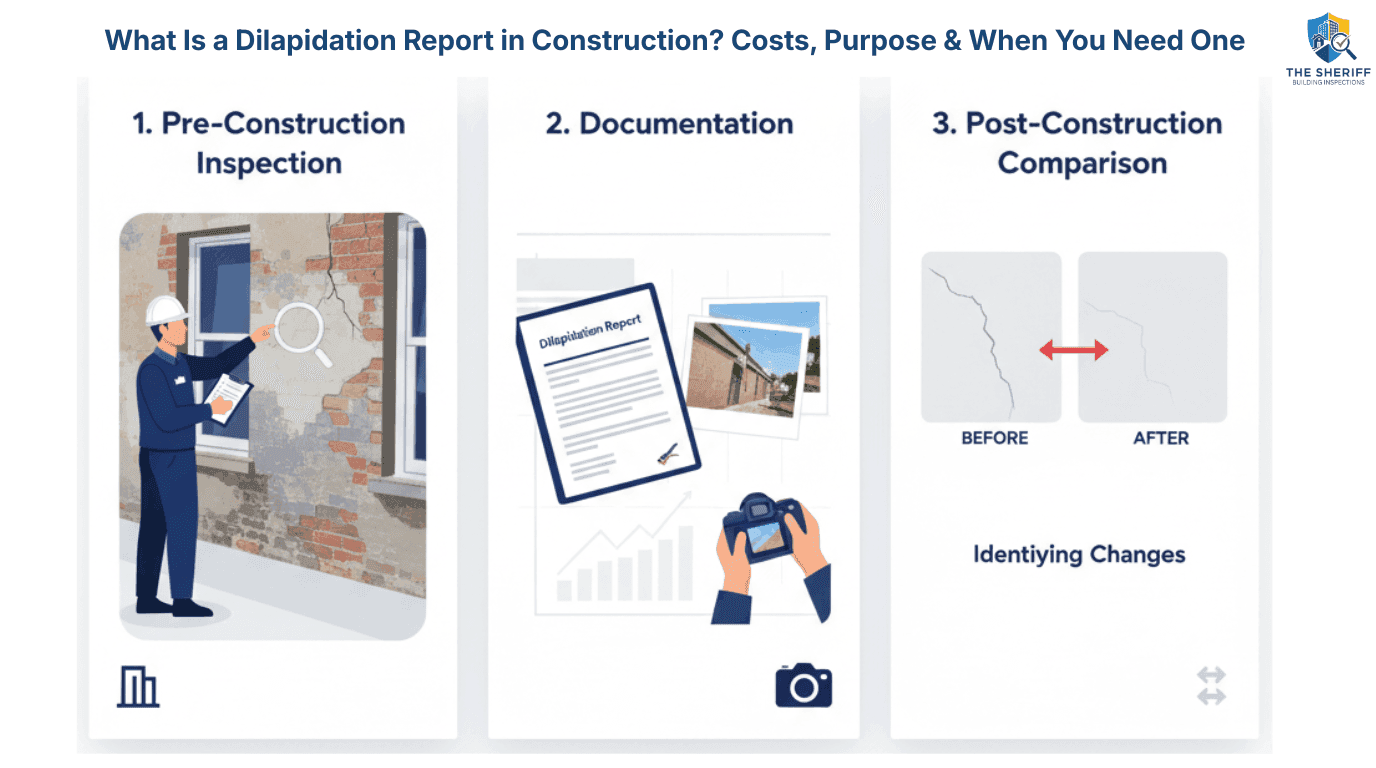
The goal is simple. It establishes a baseline. If damage appears after construction starts, you can compare the property's new condition against this original report.
Learn more about our Dilapidation Reports service here.
What Is the Purpose of a Dilapidation Report?
The primary purpose of a dilapidation report is protection. It provides security for two main groups.
1. Protection for Property Owners
You might own a home next to a new development. You need proof that your walls were crack-free before the bulldozers arrived. Without this report, it is your word against the builder's word. A professional report makes it easy to prove liability if damage occurs.
2. Protection for Builders and Developers
Builders often face false accusations. A neighbour might claim construction vibration caused an old crack in their ceiling. A signed dilapidation report proves that the crack existed before work commenced. It saves builders from paying for damage they did not cause.
What Does a Dilapidation Report Involve? Scope, Process, and Outcomes
A professional inspection is thorough. It is not a quick walk-through.
The Scope
The inspector examines all accessible areas of the property. This typically includes:
- Internal Areas: Walls, ceilings, floors, cornices, and doors. We look for settlement cracks, nail popping, and water damage.
- External Areas: Brickwork, render, cladding, windows, and roof lines.
- Site Assets: Driveways, paving, retaining walls, fences, and swimming pools.
Council Assets: Footpaths, curbing, and road surfaces directly in front of the site.
The Process
- Pre-Construction Survey: This happens before a single shovel hits the ground. The inspector documents the current state of the property.
- The Construction Phase: Work proceeds. If issues arise, the report is consulted.
- Post-Construction Survey: Once work is complete, a second inspection may occur. This compares the final condition to the initial report to identify any changes.
If you need a specialized check on specific areas like roofs, consider our Roof & Drone Inspections.
When Is a Dilapidation Report Required?
You usually need a report in three specific scenarios.
1. Council Requirements (DA Conditions)
Local councils in Sydney often mandate these reports. If you submit a Development Application (DA), the council may require a dilapidation report for neighbouring properties and council infrastructure. This ensures public assets like footpaths are not damaged during your build.
2. High-Impact Construction Works
Certain activities carry high risks of damaging nearby structures. You should get a report if the project involves:
- Demolition of existing structures.
- Deep excavation for basements.
- Piling or heavy compaction.
- Construction on unstable soil.
3. Commercial Leasing
Commercial tenants often require a Schedule of Condition attached to their lease. This limits their liability for "making good" the property when they vacate.
Contact us if you are unsure if your project requires a report.
Who Pays for a Dilapidation Report?
This is a frequent question. Who foots the bill?
The Developer or Builder: In most cases, the party doing the work pays. They are the ones creating the risk. It is their responsibility to document the site conditions to limit their liability.
The Property Owner: Sometimes a developer refuses to pay. A concerned neighbour might choose to pay for their own report for peace of mind. This ensures they have independent evidence if a dispute arises later.
The Tenant: In commercial real estate, tenants often pay for a report before signing a lease to avoid repairing pre-existing damage later.
How Much Does a Dilapidation Report Cost?
The cost varies based on the size of the property and the complexity of the site.
In Sydney, you can generally expect the following price ranges:
- Apartments / Units: $450 – $650
- Standard Residential Homes: $550 – $850
- Commercial Properties or Complex Sites: $800 – $2,500+
While this is an upfront cost, it is minimal compared to the cost of legal disputes or structural repairs.
Get an accurate quote by visiting our Services page.
Who Can Do a Dilapidation Report?
Independence is critical. You cannot write your own report. It will not hold up in court.
A dilapidation report must be conducted by a qualified third party. This usually means:
- Licensed Builders
- Building Consultants
- Structural Engineers
- Registered Surveyors
At The Sheriff, our inspectors are licensed professionals. We provide unbiased, factual reports that stand as strong evidence. We do not take sides. We document facts.
Check our credentials on our About Us page.
Dilapidation Report Examples: What to Look For
You might search for "dilapidation report examples" or a "sample dilapidation report" to see what you get. A high-quality report should always include:
- Date and Time Stamps: Proof of exactly when the inspection occurred.
- High-Resolution Photos: Blurry phone photos are useless. You need clear images of every defect.
- Detailed Descriptions: "Crack in wall" is not enough. A good report says "Hairline vertical crack in north-facing living room wall, approx. 150mm length."
- Sign-Off: Signatures from the inspector and potentially the property owner acknowledging the inspection took place.
If you are looking for other types of property reports, such as for insurance purposes, view our Insurance Condition Reports.
FAQs
Can a builder refuse a dilapidation report?
Yes. A private builder is not legally required to perform one unless it is a condition of the council DA approval. However, refusing one is risky for them. If damage occurs, they have no proof it was pre-existing.
Can I use a pre-purchase inspection as a dilapidation report?
Not usually. A Pre-Purchase Building Inspection focuses on major defects that affect a buying decision. A dilapidation report focuses on cosmetic and structural conditions specifically for liability comparison. The intent and detail level differ.
How long is a dilapidation report valid?
The report is valid for the specific construction project it was commissioned for. It should be conducted as close to the start date of construction as possible to be accurate.
Do inspectors check plumbing and electrical?
Typically, no. Standard dilapidation reports are visual inspections of structures and finishes. They do not involve invasive testing of pipes or wiring. For electrical checks, see our Electrical GPO Safety Testing.
Protect Your Asset Today
Construction damage can cost tens of thousands of dollars to fix. Do not leave your property's safety to chance. Whether you are a developer managing risk or a homeowner protecting your castle, an independent report is essential.
Get Your Dilapidation Report Today.
The Sheriff Building Inspections provides fast, detailed, and professional reporting across Sydney.
Ready to Protect Your Property Investment?
Get the clarity and confidence you need with Sydney's trusted inspection experts.

License Number: 483083C
Qualified NSW Builder (General Building Work) - Licensed to carry out residential building work in NSW