

Practical completion inspection: your new build checklist
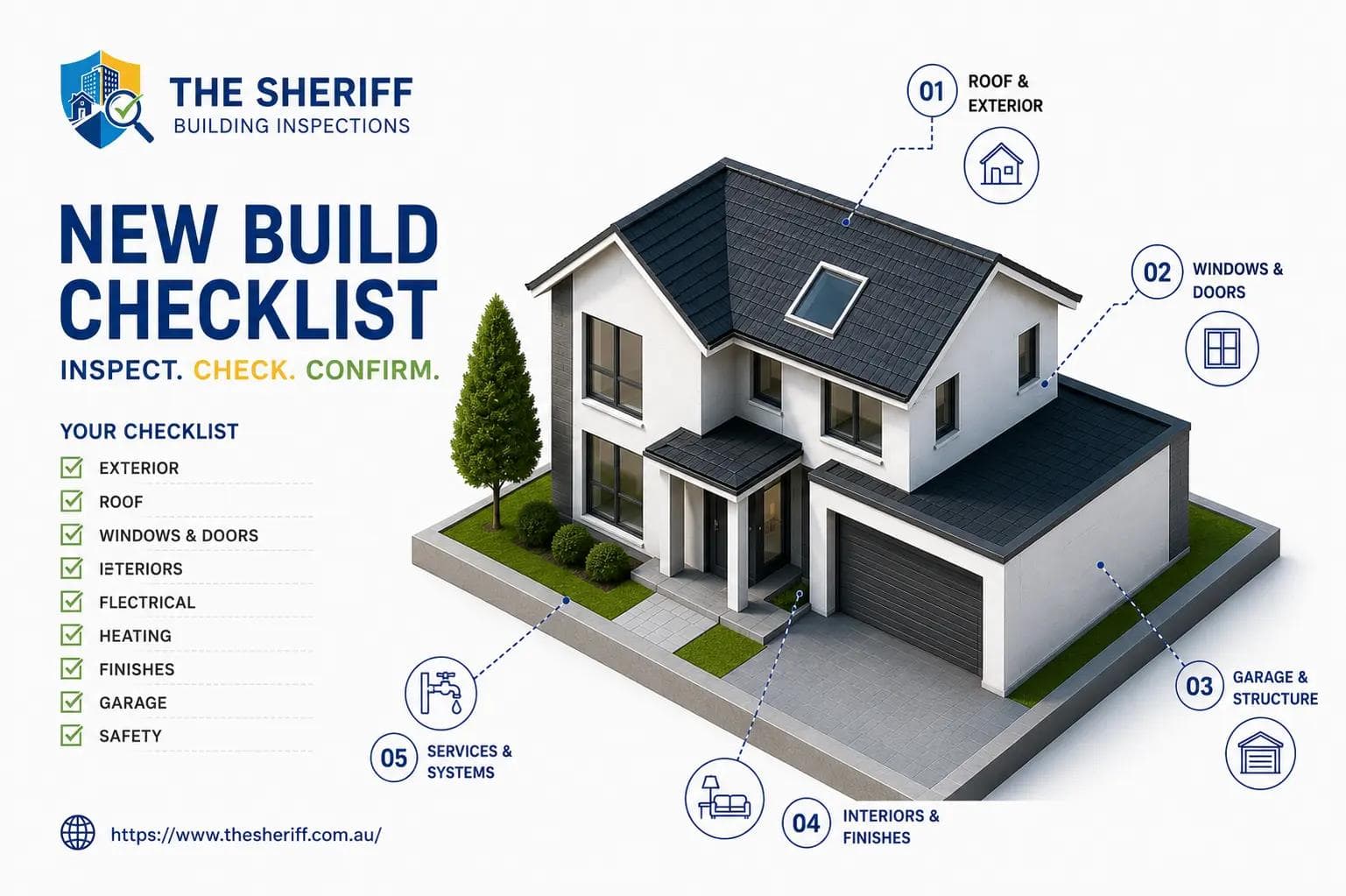
You've waited months, maybe longer, for this moment. The builder calls to say your new home is ready. You do a walk-through, spot a few paint scuffs, and sign the paperwork because you're excited and the builder seems impatient.
Three months later, water is pooling under the shower recess, tiles are lifting near the laundry, and the builder's phone manner has changed considerably since settlement.
A practical completion inspection, carried out before you sign anything, is what stands between that outcome and a clean handover. Without one, homeowners regularly find themselves holding defects that were the builder's responsibility to fix and are now their expensive problem to pursue.
A practical completion inspection is one of the most consequential quality checks in the entire building process. It's the moment where you still have leverage, where defects are the builder's problem, and where the contract is still working in your favour.
Once you sign the Certificate of Practical Completion, the dynamic shifts. At The Sheriff Building Inspections, our licensed builder inspectors approach this stage with the same eyes that built the structures we now inspect. That perspective makes a significant difference in what gets caught and what gets missed.
This guide walks you through everything: what practical completion means legally, a practical completion checklist covering every room, the defects most commonly left behind, how to document findings, and when a professional PCI inspection is worth every cent.
What practical completion actually means, and why it matters legally
What "substantially complete" means for your new home
Under the NSW Home Building Act 1989, practical completion doesn't require a perfect build. It requires a home that is fit for its intended use, with only minor defects remaining that don't prevent you from living in it. That distinction matters more than most homeowners realise.
A scratched skirting board is a snag list item. A drainage slope that doesn't meet BCA requirements, a faulty safety switch, or a bathroom waterproofing membrane that wasn't taken to the correct height are blocking defects. They must be rectified before you sign off, not added to a list of "things to sort out later."
The legal threshold sounds reasonable until you're standing in the house trying to decide which category a given defect falls into. That judgment call is exactly where trade-level expertise earns its keep. Knowing what's cosmetic and what's a compliance failure requires understanding how buildings are constructed to code, not just how to tick items off a checklist.
The practical completion certificate and what signing it triggers
When you sign a Certificate of Practical Completion (CPC), several things happen simultaneously. Possession of the home transfers to you. Insurance responsibility shifts from the builder's contract works policy to your home and contents cover. The defect liability period begins its clock.
And your leverage to demand rectification at the builder's expense starts to narrow. If you need a legal primer on how contracts are treated at practical completion, see an explanation of when a contract is considered practically complete.
Do not sign under time pressure. Final payment release is the builder's financial priority at this stage, yours is ensuring everything the contract specified has been delivered to the required standard.
If you feel rushed, request more time; you are legally entitled to it. Document everything in writing and don't let urgency become a tool used against you.
The defect liability period: your post-handover safety net
In NSW, the contractual defect liability period is typically 13 weeks (90 days) from practical completion, though the precise period is contract-dependent and owners should check their specific agreement.
During this window, the builder is obligated to repair notified defects at no cost to you. But this period is separate from, and much shorter than, the statutory warranties that run underneath it.
Under the Home Building Act 1989, statutory warranty protections extend to six years for major structural defects and two years for non-major defects from the date of completion.
These rights exist by law and cannot be waived in your contract. The key practical point: your rights don't expire when the defect liability period ends. If a major defect appears in year four, you still have a statutory claim. Document everything at handover and keep copies of your report permanently.
If you need to escalate a matter, the NSW Government explains how to submit building defect complaints in NSW.
Practical completion inspection: your room-by-room checklist
Exterior, drainage, and structural elements
Start outside. Ground grading must slope away from the slab to direct water clear of the foundation, the minimum fall required varies by local council and engineering specification, so confirm this against your approved plans and the BCA.
Drainage flowing toward the foundation causes long-term moisture problems that are expensive to diagnose and fix once the landscaping is in.
Check gutters and downpipes are correctly installed, secured, and discharged away from the structure. Inspect cladding, brickwork, render, and window frames for cracks, gaps, and missing flashing at window heads. Paths and driveways should be level, free of trip hazards, and have proper expansion joints.
Exterior defects are among the most costly to rectify post-handover because they're slow to reveal themselves. Water ingress from inadequate flashing or poor grading often doesn't appear inside for months. By the time it does, the damage extends well beyond the original fault.
Interior finishes, doors, windows, and built-ins
Work through every room systematically. Inspect walls and ceilings for cracks, plaster defects, and paint quality under both natural and artificial light. Roller marks, missed spots, uneven coverage, and visible patching all count as defects, even if they seem minor.
Check that skirting boards, architraves, and cornices are properly mitred, fixed, and free of gaps. Test every door and window: they should open, close, latch, and lock without binding or forcing. Built-in wardrobes should operate smoothly, and internal hardware should be secure and properly installed.
Cosmetic defects are still defects. They belong on the formal list before sign-off, not in a verbal conversation with the site supervisor about touching things up "over the next week or two." Verbal agreements disappear. Written defects lists do not.
Wet areas, electrical systems, and mechanical fit-out
Wet areas deserve close attention because waterproofing failures are consistently among the most expensive items on a practical completion defects list.
Check tile grout and caulking in bathrooms, showers, and laundry areas for gaps, cracking, or incomplete application. Confirm exhaust fans are installed and vent externally, not into the roof cavity. Test all taps, showers, and drainage for correct flow and adequate fall.
On the electrical side, test every GPO outlet with a plug-in device and check that the switchboard is correctly labelled with circuits matching their descriptions.
Smoke alarms must be installed and operational. Confirm the hot water system is connected and functioning, and that any HVAC units specified in the contract have been installed and operate correctly. These checks take time, but they're far faster than dealing with a failed waterproofing membrane or a non-compliant switchboard discovered after handover.
Common defects found at this stage, and why they get missed
The defects most builders leave behind
Based on our experience across PCI inspections, certain defects appear repeatedly. Poor tile grouting and incomplete caulking at wet area junctions are commonly found. Inadequate drainage fall in shower recesses is frequently overlooked because it requires measuring, not just looking.
Out-of-square door frames, particularly on internal doors installed late in the build, cause latching and locking problems that worsen over time.
Beyond the finishes, the more serious recurring issues include:
- Non-compliant safety switch or RCD installation at the switchboard
- Missing or incorrectly installed window head flashing
- Incomplete or absent insulation, particularly in ceiling areas near eaves
- Switchboard labelling errors where circuits are mislabelled or unlabelled
- Waterproofing membranes that haven't been taken to the required height in wet areas under AS 3740
These aren't difficult to find if you know what to look for. The challenge is that most homeowners don't, and builders know it.
Cosmetic vs. structural vs. compliance defects: how to tell the difference
Not all defects carry equal weight. Cosmetic defects, paint drips, minor scratches on floors, a slightly uneven cornice join, are legitimate items for your list but don't typically justify delaying handover.
Structural defects, like incorrect wall bracing, a cracked structural beam, or foundation settlement issues, require rectification before sign-off, full stop. Compliance defects sit in between: they may not be visible problems today, but they fail Australian Standards or the BCA and create legal liability and safety risks over time.
Understanding this distinction lets you prioritise what you push back on firmly and what goes on the snag list. A professional inspector who is also a licensed builder can make this call accurately. Someone working from a checklist alone often cannot.
How to document defects and protect yourself before signing off
Writing a proper defects list before you sign anything
Every defect you find needs to be documented before the handover meeting. Photograph each item with the date visible in the frame or in the file metadata. Describe the location precisely ("shower recess, master ensuite, NE corner, grout cracking from tile row 2 to floor level") and note the nature of the defect clearly.
Compile this into a written defects list and submit it to the builder via email before or at the handover meeting, not in a verbal discussion during the walk-through.
Email creates a paper trail that can't be revised or denied later. Keep every response from the builder in writing as well. Verbal promises to fix things "next week" have no enforceability. A written acknowledgment of a defect list does.
Holdbacks, retention, and when to release final payment
In Australian residential building contracts, the standard holdback practice allows homeowners to retain a proportional amount of the final payment against outstanding defects and incomplete work. The principle is that the amount withheld should reflect no more than twice the value of the defect rectification, it is not a blanket penalty against the builder.
In NSW, you can legally withhold final payment where defects prevent practical completion or where identified defects are serious enough to justify retention. The critical rule: withholding must happen before payment is released, not after. Once you've paid, your leverage changes significantly. Do not release the final payment under pressure until defects have been physically rectified and re-inspected.
A promise to return and fix something is not rectification. Rectified work that you can see and verify is. For practical guidance on this process, see advice on withholding final payment for defects in NSW.
When to schedule a practical completion inspection, and what a licensed builder finds that others miss
The difference between a standard building inspector and a licensed builder
In NSW, the title "building inspector" doesn't require a builder's licence. Many inspectors are trained observers who work from inspection standards and checklists. That's a legitimate role with real value. But a licensed builder brings something different to a pre-completion inspection: hands-on knowledge of how structures are actually built, what code-compliant workmanship looks like from a contractor's perspective, and specifically which shortcuts are commonly taken at the finishing stage when site pressure is highest.
A licensed builder looking at a waterproofing membrane knows the AS 3740 requirements from having specified and supervised the work themselves. They recognise a non-compliant drainage fall because they've set drainage falls.
They spot a framing deviation because they know what correct framing looks like from both sides of the wall. This isn't a criticism of building inspectors generally; it's a clear statement of what additional expertise delivers at the most consequential point in the build. If you're earlier in the purchase process, we also offer pre-purchase building & pest inspections to protect you before exchange.
How a professional PCI inspection works and what the report covers
A professional practical completion inspection conducted by The Sheriff Building Inspections covers the full property using AS 4349.1 standards as the compliance benchmark.
Our inspection includes thermal imaging to detect moisture ingress, insulation gaps, and hidden defects not visible to the naked eye, as well as GPO testing to confirm electrical outlet compliance across the property.
Every defect is documented with photographs, precise location descriptions, and a written assessment of its nature and severity. Learn more about our approach to stage inspections and how they protect your handover position.
Our reports are delivered within 24 hours, formatted to hand directly to your builder, solicitor, or certifier. At $465 to $525 for a Sydney new build, the cost is straightforward.
The defects caught before you sign off are the builder's responsibility to fix. The same defects found six months after handover are a far more complex and expensive conversation, and one where the Home Building Act 1989 still gives you rights, but exercising them is considerably harder without a contemporaneous record.
Your final check before the keys change hands
Your practical completion inspection is the moment where your leverage is highest and your rights are clearest. Once you sign the certificate, the dynamic shifts, the clock starts on your defect liability period, and the builder's financial motivation to cooperate begins to fade. Running a structured room-by-room pre-completion inspection, documenting every defect in writing before you sign anything, and understanding your rights around holdbacks and statutory warranties all reduce the risk of costly problems after handover.
The statutory warranty protections under the NSW Home Building Act 1989 are genuinely strong. Six years for major structural defects, two years for non-major defects. But those protections work best when you have clear documentation from the day you took possession.
A professionally prepared PCI report gives you exactly that: a contemporaneous record of your home's condition at handover that is strong documentary evidence in any subsequent dispute. For practical tips and wider reading on inspection topics, check our blog.
If you're approaching practical completion on a new build in Sydney, book your pre-handover inspection with The Sheriff Building Inspections before you attend the handover meeting.
Our licensed builder inspectors cover a 60km radius of the Sydney CBD, operate 24/7 for urgent bookings, and deliver every report within 24 hours. Call us or book online. This is the one inspection where getting it right pays for itself many times over.
Ready to Protect Your Property Investment?
Get the clarity and confidence you need with Sydney's trusted inspection experts.

License Number: 483083C
Qualified NSW Builder (General Building Work) - Licensed to carry out residential building work in NSW