

Handover vs Building Inspection: What’s Actually Different?
Picture two buyers on the same weekend. One is about to bid at auction on a 20-year-old terrace in Marrickville. The other is getting the call that their brand-new house and land package in Kellyville is ready for handover. Both have been told to "get a building inspection." Both book one. But the inspection each of them actually needs is completely different, and getting this wrong can cost serious money.
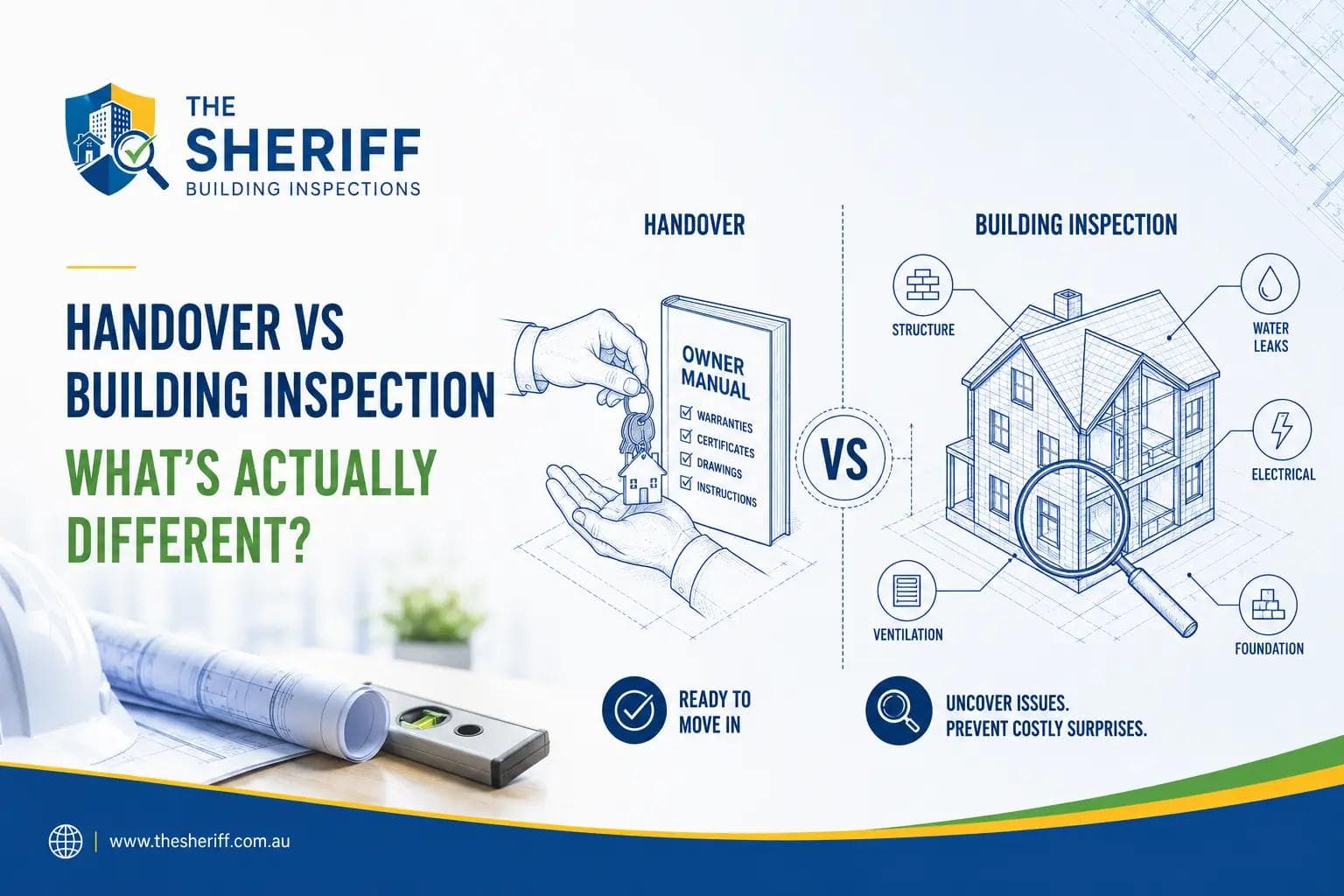
So what is the difference between a handover inspection and a standard building inspection? A handover inspection, formally known as a practical completion inspection, checks a newly constructed home against the builder's contract, the approved plans, and Australian Standards before you pay the final invoice and accept the keys.
A standard building inspection assesses the overall condition of an existing property before you commit to buying it. The scope, the timing, the legal implications, and the person best placed to conduct each one are all distinct.
Understanding which inspection applies to your situation protects your money, your warranty rights under the Home Building Act 1989, and your legal position at one of the most financially significant moments of your life.
The Sheriff Building Inspections handles both inspection types, with every inspection conducted by a qualified licensed builder who understands both construction compliance and existing property condition assessment.
What is the difference between a handover inspection and a standard building inspection?
The handover inspection: your final check before you accept the keys
A handover inspection, also called a practical completion inspection or PCI, is a formal quality-control step conducted on your behalf just before you accept a completed new build from your builder.
Its job is to measure the finished property against the building contract, the approved plans, and the National Construction Code, confirming the builder has delivered what they promised. Defects and incomplete work identified at this stage become the builder's legal obligation to fix before settlement, not yours.
This is not the same as the certifier's mandatory final inspection. The certifier checks that the structure meets minimum building code compliance and issues the Occupancy Certificate, but they do not check workmanship quality, contract finishes, or whether the kitchen joinery aligns with your contract specifications.
An independent pre-handover inspection largely addresses workmanship and contract-finish issues not covered by the certifier, working through the property in detail to catch what a code check is never designed to find.
The standard building inspection: a condition report for buyers of existing homes
A standard pre-purchase building inspection evaluates the current condition of an established property for a prospective buyer. It is an independent snapshot of the home's structural integrity, safety, and overall state, conducted under Australian Standard AS 4349.1-2007.
The focus is squarely on what is there now: existing defects, wear and tear, water damage, safety hazards, and evidence of past or ongoing problems.
There is no contract or construction drawing to measure against. The inspector is not asking whether the property was built correctly; they are asking whether the property, as it stands today, has problems that should affect your buying decision.
The outcome is a condition report that helps you negotiate a lower price, request vendor rectification, plan future remediation, or walk away altogether.
When in the property journey each inspection takes place
Timing the handover inspection correctly
A handover inspection should happen after your builder notifies you that the property is approaching practical completion, but before you make the final contract payment and physically accept the keys.
Most residential building contracts give you a window of 7 to 14 days after receiving the practical completion notice to raise any defects formally, check your specific HIA or MBA contract terms, as the exact period can vary.
Miss that window and the leverage you had to compel the builder to fix things disappears quickly. For practical guidance on completing the practical completion paperwork.
The process follows a clear sequence
1. The certifier issues the Occupancy Certificate, confirming minimum code compliance.
2. Your independent inspector works through the property in detail before formal handover.
3. You present the defects report to the builder.
4. The builder rectifies the listed items before you sign off and pay the final instalment.
This ordered process is what keeps the financial risk on the builder's side of the ledger, where it belongs at this stage.
Timing the standard building inspection correctly
For buyers of existing properties, the standard building inspection should happen during the cooling-off period or as a formal condition of the contract, before the exchange becomes unconditional, consistent with guidance under AS 4349.1-2007 and NSW consumer property buying guidance.
In a competitive Sydney market, some buyers feel pressure to skip this step or rush it to match an auction timeline. That pressure is understandable, but the financial exposure is significant: once you unconditionally exchange, every defect the report might have flagged becomes your cost to carry.
Book the inspection as early as possible once you have access to the property. That gives you time to review the report, ask follow-up questions, and make a clear-headed decision without the clock working against you, whether you are buying at a private treaty or navigating the tighter timelines of an auction campaign.
What each inspection actually looks for
The new-build inspection checklist: what a handover report covers
A handover inspection works methodically through the property against both the approved plans and the National Construction Code. The scope is broad because every element of the build should have been delivered to a contractual standard. A professional handover report from a licensed builder will typically assess:
- Structural elements, roofing, cladding, and all waterproofing membranes
- Joinery, tiles, paint, flooring, and all finish work checked against workmanship tolerances
- Plumbing fixtures, electrical outlets, GPO testing, and installed appliances
- Doors, windows, stairs, handrails, balustrades, and decking
- Site drainage, driveways, paths, and any retaining walls included in the contract
The output is a documented defects report, sometimes called a snag list or snagging inspection record, that formally records each issue with photographic evidence and references to what was promised in the contract versus what was actually delivered. This documentation is what legally obliges the builder to act.
Some firms produce handover reports that run to 50 pages or more for a full house, a reflection of just how detailed a thorough builder-inspector assessment needs to be.
What a standard inspection targets on an existing property
A standard pre-purchase inspection focuses on what time, weather, and previous owners have done to the property. The inspector assesses structural integrity across foundations, walls, roof frames, and drainage.
They look for evidence of moisture intrusion, water damage, and active or historical leaks, as well as safety hazards, illegal works, and deteriorating elements that create risk for a buyer.
Thermal imaging and moisture detection tools allow an inspector to find hidden problems inside walls and under surfaces that a visual-only check would completely miss, and reputable inspectors use them as standard practice rather than an optional add-on.
Critically, the inspector does not check the property against a contract because no contract exists. The report is a condition assessment, not a compliance audit. Its purpose is to give you a clear, honest picture of what you are actually taking on before the contract locks you in.
Who should carry out each type and what the report looks like
Qualifications that actually matter for each inspection type
For a handover inspection, you need someone who understands construction at a trade level, not just property conditions. A licensed builder can read approved plans, identify construction non-compliance, assess whether a finish meets Australian Standards, and distinguish between a minor cosmetic issue and a serious workmanship defect.
A general building inspector without a builder's licence may identify visible problems but lack the construction knowledge to assess whether they breach contract or code requirements.
For a standard pre-purchase building inspection, AS 4349.1-2007 governs the scope and report format, and in NSW the inspector should hold a current licence and carry appropriate professional indemnity and public liability insurance.
The Sheriff Building Inspections uses a licensed builder for both inspection types, meaning the same construction-level expertise applies whether the property is a brand-new build or a 30-year-old Federation home.
How the two report formats differ
A handover report is structured around the contract and the approved plans. Each defect is referenced to what was promised versus what was built, with photographs, location descriptions, and a clear record the builder can be held to. These reports are detailed by design because they serve as a legal document within the Defects Liability Period.
A standard building inspection report under AS 4349.1-2007 is a condition assessment where findings are categorised by severity and section of the property.
At The Sheriff Building Inspections, standard inspection reports are written in plain language and structured so buyers can act on the findings immediately, without needing a builder to translate the report for them. Reports are typically delivered within 24 hours of the inspection, so you are never left waiting when time is short.
For more on expected turnaround times, read How Long Does a Building and Pest Inspection Take in Sydney?
What happens when defects are found
Your legal position after a handover inspection
Defects documented before you accept practical completion sit firmly within the builder's contractual and statutory obligations. Under the Home Building Act 1989 (NSW), builders carry statutory warranties covering major defects for up to six years from completion and minor defects for two years. These warranty rights cannot be contracted away, regardless of what the building contract says.
If you sign off and accept the keys without a formal independent inspection, proving that specific defects existed before handover becomes significantly harder. The Defects Liability Period, which typically runs for 13 weeks under a standard HIA contract, though it can extend to 12 months for more complex projects, only starts from the date of practical completion. Getting defects on the record before that date is one of the most effective ways to ensure the builder, not you, bears the cost of fixing them.
What defects mean during a standard building inspection
Defects found on an existing property during a standard inspection give you direct negotiating power. You can request a price reduction to account for the cost of repairs, ask the vendor to rectify specific issues before settlement, or walk away during the cooling-off period with your deposit intact. The report becomes your documented evidence and your leverage in any negotiation.
Unlike a handover situation, there is no builder's statutory warranty attached to an existing home. Once the contract is unconditional and settlement occurs, the defects identified in the report become your financial responsibility to address. That report also serves as documented baseline evidence for future insurance claims or renovation planning, so its value extends well beyond the purchase negotiation itself.
Which inspection do you actually need and when
A simple way to decide
If you are about to accept a newly constructed home from a builder, whether that is a house and land package, a spec home, or an off-the-plan apartment, you need a handover inspection before you sign the practical completion notice and pay the final instalment.
If you are buying an existing established property, you need a standard pre-purchase building inspection, ideally combined with a pest inspection via our pre-purchase building & pest inspections, before your contract goes unconditional. The timing of each inspection is what determines whether the cost of any defect falls on the builder or on you.
Some buyers need both. If you are purchasing a near-complete new build from a developer on the secondary market, an inspector needs to apply both lenses simultaneously, assessing construction compliance against the approved plans and overall property condition as a prospective buyer. This is a situation where a licensed builder-inspector, rather than a general property inspector, is especially valuable.
Why using the same company for both types makes practical sense
The Sheriff Building Inspections offers both inspection types conducted by the same licensed builder across Sydney. That means the same construction-level expertise and report quality on every job, with a single point of contact whether you are taking delivery of a new home in the Hills District or buying an established property in the Inner West. No guessing about qualifications, no subcontractors, and no variation in the standard applied from one inspection to the next.
If you need dedicated handover support, see our Practical Completion & Handover Inspections.
Make the right call before you commit
Understanding the difference between a handover inspection and a standard building inspection comes down to this: a handover inspection measures quality and compliance on a new build against the contract and Australian Standards; a standard building inspection measures overall condition on an existing property before you commit to buying it. They serve different purposes, apply at different stages of your property journey, and produce different types of reports.
What they share is timing sensitivity. The handover inspection must happen before you accept the keys and trigger the Defects Liability Period. The standard building inspection must happen before exchange becomes unconditional. In both cases, booking the right inspection at the right moment is what determines whether the cost of any defect falls on the builder or the vendor, or whether it falls on you.
Identify which stage you are at, book the right inspection before the financial commitment locks in, and use a licensed builder-inspector who can read both construction documents and existing property conditions with equal authority. The Sheriff Building Inspections is available for pre-handover and pre- purchase inspections across Sydney.
Book your inspection today and get your report back fast.
Ready to Protect Your Property Investment?
Get the clarity and confidence you need with Sydney's trusted inspection experts.

License Number: 483083C
Qualified NSW Builder (General Building Work) - Licensed to carry out residential building work in NSW