

Apartment Handover Inspection: Spot Defects Before You Move
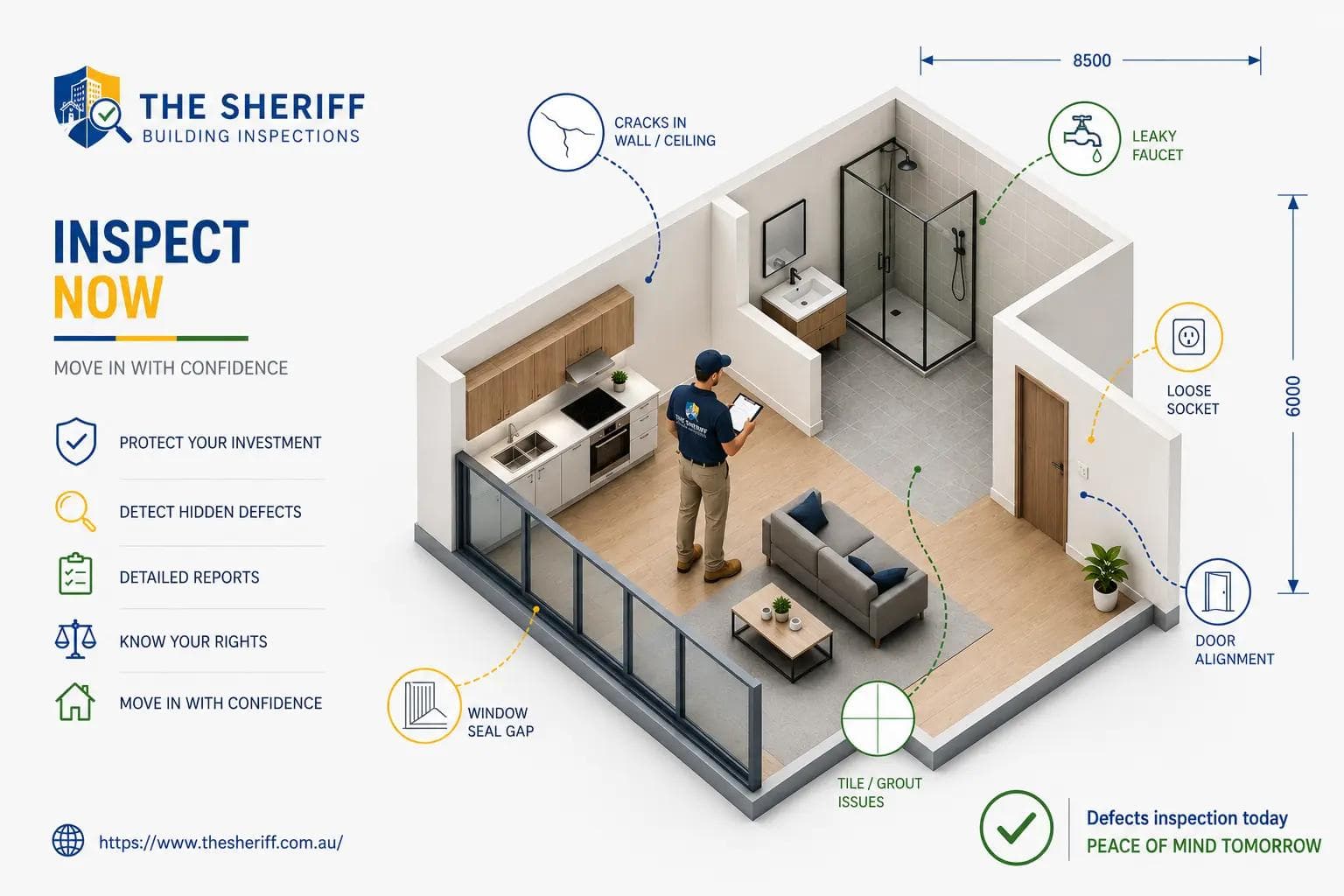
An apartment handover inspection is your last real opportunity to hold the developer accountable before settlement, and the stakes are higher than most buyers realise. According to one research, waterproofing failures affect roughly 40% - 42% of apartment builds. That number should stop you in your tracks.
A pre-completion inspection without a proper checklist means defects get missed, and once you sign off on handover, getting them fixed becomes a fight. Your leverage disappears the moment you accept the keys and settle.
This guide covers exactly what to check during your walkthrough, which defects show up most often in new builds, how to document and submit issues so they can't be dismissed, and what your legal rights look like before and after settlement.
What an apartment handover inspection actually involves
This is not the same as a standard pre-purchase inspection on an existing property. A pre-completion inspection, sometimes called a practical completion inspection or PCI, takes place on a brand-new build before you take possession. The purpose is to formally record defects and require the developer to fix them before settlement, while your bargaining position is at its strongest.
Handover inspection vs pre-purchase inspection
The distinction matters because the scope, standards, and paperwork are entirely different. A pre-purchase inspection is conducted before exchange on an existing property, assessing its current condition and age-related wear.
A pre-completion inspection is conducted on a newly constructed apartment against the contract specifications, the builder's obligations, and Australian Standards. You're not just assessing conditions; you're verifying that what was built matches what was promised.
When to schedule your pre-settlement inspection
Timing is critical. The inspection should happen after the builder declares practical completion but before you settle. Most buyers have a window of 7 to 14 days. Schedule it as early as the builder allows, because you need enough time to prepare a defect report, submit it formally, and request rectification before your settlement date arrives. Don't let that window close without using it.
Who should be present on the day
You should be there, along with your conveyancer or solicitor if the schedule allows. The developer's site manager will typically walk through with you. Your role on the day is to inspect, not to negotiate.
Bring a checklist, bring your phone to photograph everything, and avoid being talked out of recording a defect because the site manager says it'll be "fixed before settlement." If it's not documented in writing, it doesn't exist.
The most common defects found at new apartment handovers
Defects at handover fall into three bands: cosmetic, structural, and safety-critical. Understanding the difference matters because it shapes how you prioritise your defect report and what the developer is legally obligated to address.
Waterproofing failures and moisture issues
By remediation cost and long-term structural risk, waterproofing failures are among the most serious defects found in new builds, and they're also among the most common.
In most cases, waterproofing failures in wet areas, bathrooms, balconies, laundries, affect the majority of new apartment builds. They aren't cosmetic. A failed waterproofing membrane leads to water penetration behind tiles, damp in walls, mould growth, and eventual structural damage.
Rectification is also invasive and expensive once you've settled. Identifying waterproofing issues before settlement is far more valuable than any other single item on your final handover checklist.
Cracked tiles, poor paint finishes, and substandard workmanship
These are the classic snagging list items that most buyers notice first: cracked or chipped tiles, uneven grout lines, paint runs, gaps in cornices, poorly fitted skirting boards, and misaligned cabinet doors.
Individually, they look minor. Collectively, they signal workmanship that falls short of contract specifications. Document all of them, even the ones that seem trivial, because they form the overall picture of quality and they are legitimate defects under the contract.
Faulty fixtures, electrical faults, and safety-critical defects
Non-functioning GPOs (power points), faulty light fittings, poorly sealed windows, non-compliant balustrades, and smoke detectors that aren't installed or operational all belong in a separate category.
These defects cannot wait.
They need to be flagged immediately, in writing, and treated as urgent items in your defect report. A non-compliant balustrade on a high-rise apartment is not a cosmetic issue; it's a safety risk that the developer must address before handover.
Apartment Handover Inspection: Room-by-Room Checklist
Work through the apartment systematically. The goal of your walkthrough is to produce a documented punch list, not a casual impression. Move room by room, recording defects as you go with photographs and written notes before you leave the building.
Bathrooms, wet areas, and laundry
Check grout and caulking around all tiles, paying particular attention to junctions between the floor and wall. Run taps and check under vanities for leaks. Test the shower for drainage and water pressure.
Look for any sign of waterproofing bubbling or separation at wall and floor edges. Test the exhaust fan. Flush the toilet and check cistern operation. These areas carry the highest defect risk and deserve the most time.
Kitchen, living areas, and bedrooms
Test every GPO with a phone charger or plug tester. Check that all doors open, close, and latch correctly without binding. Inspect flooring for scratches, gaps, or uneven joins. Examine ceiling and wall paint for runs, patchy coverage, or inconsistent finish.
Test all built-in joinery, including drawers and overhead cupboards. In bedrooms, check that closet rods and shelving are secure, and that window locks operate correctly.
Balconies, windows, doors, and common property
Check balcony drainage and look closely at the waterproofing junction where the wall meets the floor. Test all window locks and sliding mechanisms.
Confirm your storage cage number matches the contract and that access works. Walk the common property relevant to your lot: your car space, the lobby, your letterbox. Note anything that deviates from the contract inclusions, those are legitimate defects too.
If nearby construction could affect your lot, consider ordering a dilapidation report to document pre-existing damage.
How to Document Defects During Your Apartment Handover Inspection
Finding defects is only part of the work. How you record and submit them determines whether the builder acts or disputes. Vague complaints get ignored. Specific, documented evidence is hard to argue with.
What good defect documentation looks like
Timestamped photographs are non-negotiable. Take wide shots to establish the location within the room and close-up shots to show the defect clearly.
Pair every photo with a written description that includes the room, the exact element, the nature of the defect, and whether it's cosmetic, functional, or structural.
A chronological defect log, with dates, descriptions, and photo references, carries real evidentiary weight if the dispute escalates beyond a simple email exchange, particularly when presenting to NSW Fair Trading or NCAT.
Submitting your defect report to the developer
Submit your move-in inspection checklist and defect report in writing within the window specified in your contract. Use email so there's a timestamp and a paper trail.
Be specific and reference each defect by room and element. Avoid vague language like "bathroom looks bad"; write "cracked floor tile at base of shower, south-west corner, visible gap in waterproofing membrane at wall junction."
Keep copies of every communication, including the developer's responses and any periods of silence.
Your rights, timelines, and what happens after settlement
The pre-settlement walkthrough isn't the end of your defect protection. Buyers in NSW have contractual and statutory rights that extend well beyond the day they collect keys, and knowing these timelines gives you real leverage.
Practical completion, the defect liability period, and what they mean
Practical completion is the date from which most timelines run. In most residential construction contracts in NSW, the defect liability period runs 12 months from practical completion, during which the builder is contractually obligated to rectify notified defects.
Beyond the contract, statutory warranties under the Home Building Act 1989 provide six years of protection for major defects (those affecting structural integrity or habitability) and two years for other defects. These statutory warranties override weaker contract terms.
The 90-day defects inspection and what to check
Many contracts include a 90-day defects inspection as a formal post-occupation review. This is the point where you can formally document defects that only became apparent after living in the apartment.
Shower leaks that took a few weeks of use to manifest, doors that warp with seasonal changes, and ventilation that's clearly under-spec all belong here.
Document these with the same rigour as day-one defects: timestamped photos, written descriptions, and written submission to the developer.
When the developer refuses to fix defects
If the builder fails to act on a notified defect within the timeframe specified in your contract, commonly between 14 and 28 days, though this varies by agreement, your options include escalating through NSW Fair Trading, seeking independent expert reports to support mediation, or pursuing legal remedies through NCAT.
You can start the escalation process by lodging formal building defect complaints with the relevant NSW authority. A court-admissible inspection report from a licensed builder makes a significant difference at this stage.
A general defect list carries far less weight than a formal AS 4349.1-compliant report from a qualified inspector.
Why a licensed builder catches what a standard inspector misses
There's a meaningful difference between someone working through a checklist and a licensed builder who has spent years on construction sites. One sees what's visible; the other reads the build against what was specified, what the standard requires, and how the work was actually executed.
Trade-level expertise in a handover inspection
A licensed builder conducting a new apartment handover sees workmanship through the lens of construction knowledge. They identify non-compliant waterproofing membranes, substandard concrete finishes, and faulty electrical installations that a generalist inspector may not recognise as defects.
Thermal imaging adds another layer, detecting hidden moisture behind tiles and within walls that shows no visible signs yet but can cause serious and costly damage if left unaddressed, the kind of problem that becomes exponentially harder to fix after settlement.
How The Sheriff Building Inspections approaches apartment handovers
At The Sheriff Building Inspections, every apartment pre-completion inspection is conducted by a qualified licensed builder, not a subcontractor or generalist inspector. Reports are AS 4349.1-compliant, meaning they carry real weight if you need to escalate a defect dispute with the developer, through NSW Fair Trading, or at NCAT.
Thermal imaging is available on inspections to find moisture and waterproofing issues that wouldn't be visible to the naked eye. If you're collecting keys on a new build in Sydney, this is the inspection that gives you the full picture before you sign off.
Don't sign off until you're confident
The apartment handover inspection is the buyer's last, best opportunity to hold the developer accountable before settlement. Walk in with a checklist, document everything with timestamped photos, submit your defect report in writing, and know your rights under the defect liability period and the Home Building Act 1989.
Cosmetic issues are one thing. Waterproofing failures, faulty electrical work, and non-compliant safety features are another category entirely, and those are the defects that cost real money if they're missed at handover.
A licensed builder conducting your inspection doesn't just tick boxes; they read the build the way it was constructed, with trade-level knowledge that identifies what a checklist alone can't.
Whether you use this guide to conduct your own walkthrough or bring in professional support, don't hand over your bargaining position before you've used it. Book your inspection early, get every defect on the record, and don't settle until you're satisfied the developer has been put on notice.
You can also consider professional Stage Inspections Sydney to monitor construction progress before the final handover.
Ready to Protect Your Property Investment?
Get the clarity and confidence you need with Sydney's trusted inspection experts.

License Number: 483083C
Qualified NSW Builder (General Building Work) - Licensed to carry out residential building work in NSW