

12 Hidden Defects Sydney Buyers Miss Before Signing
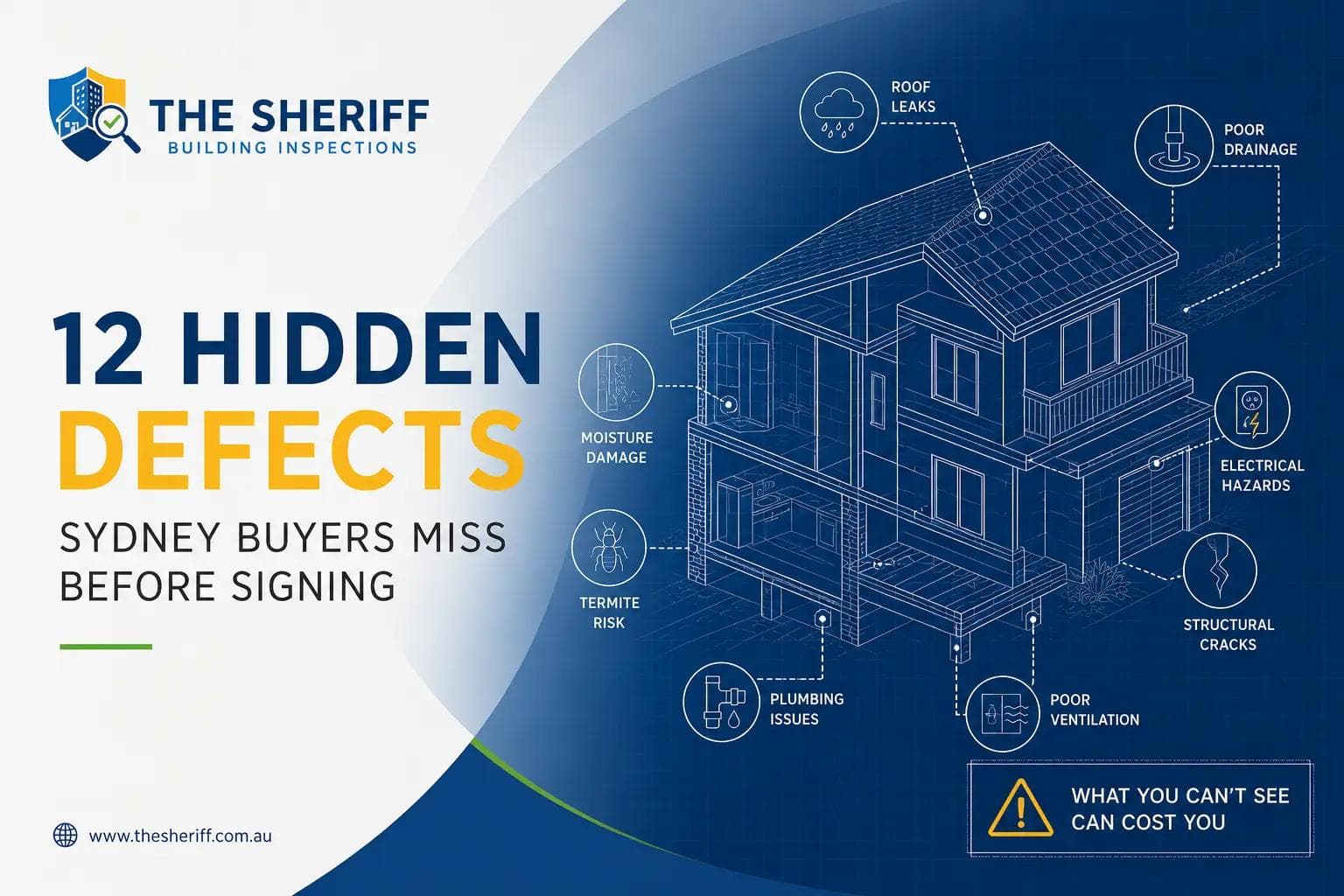
Sydney properties look immaculate at open inspections. Fresh paint, clean carpets, a renovated kitchen, and you're ready to sign. What you can't see are the termites eating through the subfloor framing, the balcony membrane failing silently above the living room, or the moisture reading in the bathroom wall that's been sitting at double the safe threshold for years.
If you're wondering what the most common hidden defects found in Sydney properties actually are, these are the issues licensed builder-inspectors uncover in homes across the city, and the ones buyers most consistently walk past.
Some leave no visible surface trace at all. Others are hidden behind fresh paint applied specifically to conceal them before sale. All of them carry real financial consequences, and most are preventable with the right inspection before you exchange.
This guide gives you the warning signs to look for, the repair cost context to make sense of what you're facing, and a clear picture of when a professional inspection isn't optional.
Why Sydney properties are a breeding ground for hidden defects
Two forces combine to make Sydney one of Australia's highest-risk markets for concealed property defects: the age and construction era of its housing stock, and the local climate. Understanding both helps you assess which properties carry the greatest risk before you even walk through the door.
Sydney's building eras and what each one hides
Different construction periods carry distinct risk profiles. Pre-1990 terrace homes and fibro cottages were built with untreated timber frames and basic subfloor ventilation, making them highly vulnerable to termite entry and rising damp.
Brick veneer homes from the 1990s and early 2000s have been found to sometimes have inadequate waterproofing in wet areas, particularly around shower bases and laundry connections.
The 2010s apartment construction boom is in a category of its own: time and cost pressures during that period compromised build quality to the point where NSW Building Commission audits recorded defect rates as high as 85% in buildings from that era.
Renovated properties deserve special mention. A fresh bathroom renovation, new paint throughout, or recently installed flooring can easily conceal years of accumulated moisture damage, active cracking, or termite activity in the framing behind the walls. At open inspections, these properties look like the best deal on the street. They often carry the highest risk of any property type.
How Sydney's climate and soils accelerate damage
Sydney's combination of heavy summer rainfall, high humidity, and clay-heavy soils creates conditions where defects exist and worsen fast. Reactive clay soils expand when wet and contract when dry, causing ongoing foundation movement that generates structural cracking over time.
High humidity accelerates mould growth in poorly ventilated subfloors. Thermal cycling between hot summers and mild winters causes materials to expand and contract repeatedly, opening joints, splitting sealants, and widening existing cracks with every passing season.
Most common hidden defects found in Sydney properties: water damage
Water is responsible for the majority of serious, expensive defects found in Sydney properties. The following five defects all stem from moisture entering where it shouldn't, and all of them are significantly cheaper to fix when caught early.
Defect 1 to 3: Rising damp, wet area failures, and balcony leaks
Waterproofing is the single most prevalent serious defect in NSW strata buildings, affecting 22% of registered buildings in the most recent available NSW Building Commission data (2022, 2024), and up to 42% in earlier audits of recently completed properties.
Waterproofing defects also appear in 34.4% of Fair Trading NSW cases, making them far and away the most common source of building disputes in the state. Rising damp typically shows as tide marks on lower walls, paint bubbling at floor level, or a persistent musty odour in ground floor rooms.
Waterproofing failures in bathrooms and laundries are particularly deceptive. The visible signs, grout staining, loose tiles, a slightly soft feel near the shower base, are minor. The real damage is happening silently behind the tiles, where water has been tracking into the wall cavity and subfloor structure for months or years.
Balcony and podium leaks are a subset of the same problem: membrane failures allow water to penetrate through to structural slabs below, often causing damage that doesn't appear at the surface until it's extensive.
Defect 4 and 5: Subfloor moisture and hidden plumbing leaks
Subfloor voids in older homes trap moisture when ventilation is inadequate, rotting timber bearers and joists from the inside out. Walk across a floor and feel for a spongy or springy sensation underfoot.
Check for musty smells coming through floor vents. Look for efflorescence (white mineral deposits) on subfloor brickwork when you can access the subfloor space. These are the signs that moisture has been sitting in that void long enough to begin breaking down the structural floor system.
Internal plumbing leaks are harder to detect without scanning equipment. Water staining on ceilings below bathrooms, discolouration along skirting boards at floor level, or unexplained increases in water bills all warrant further investigation. Without non-invasive moisture scanning, these defects are often missed entirely at standard property inspections.
Structural and timber defects buyers walk past without knowing
These four defects are responsible for some of the largest repair bills in Sydney property purchases. They're also the ones most effectively hidden by cosmetic preparation before sale.
Defect 6 and 7: Concealed termite damage and subfloor rot
Termites consume timber from the inside out, leaving a thin outer veneer that looks completely intact. The result is structural framing that appears fine on the surface but sounds hollow when tapped, crumbles under pressure, or reveals mud-filled tunnels when opened.
Visual warning signs include blistering or bubbling paint on interior walls, pencil-sized mud tubes running up external walls or foundations, and frass (tiny wood-coloured pellets resembling sawdust) near skirting boards or window frames. Sticking doors and windows are a late-stage sign that the framing behind them has already been significantly compromised.
In Sydney's older homes with untreated timber subfloors, termite-driven rot can render entire sections of the structural floor system unsafe without any surface evidence at all.
Defect 8 and 9: Foundation cracking and structural movement
Not all cracks are equal, and knowing the difference matters. Hairline cracks in render are generally cosmetic. Diagonal stair-step cracking in brickwork, cracks wider than approximately 3, 5mm, or cracks that are wider at the top than the bottom can indicate genuine structural movement and warrant professional assessment.
In Sydney, reactive clay soils are the primary driver: seasonal shrink-swell cycles shift footings unevenly, and that movement transfers through the frame over time, generating characteristic crack patterns at wall corners, door openings, and window reveals.
Fresh paint or wallpaper applied over existing cracking is one of the most common pre-sale preparation tactics. A visual inspection at an open home simply can't distinguish between a recently painted wall and one that's been painted to cover a crack that's been active for three years. This is exactly where trade-level construction knowledge changes the outcome of an inspection.
Electrical and fire safety defects that put buyers at real risk
Defects 10 and 11 sit in a different category. They're not just expensive to fix, they carry direct safety and legal obligations that don't disappear after settlement.
Defect 10: Faulty wiring and ageing electrical systems
Pre-1990 Sydney homes commonly contain single-core wiring with no earth, ceramic fuse boards, and unprotected GPO circuits that don't meet current AS/NZS 3000 wiring standards.
These systems aren't always immediately dangerous, but they create significant liability and insurance complications. Signs to watch for include flickering lights, warm or discoloured power outlets, frequent tripping of circuit breakers, and a switchboard that still uses ceramic fuses rather than modern circuit breakers. Termite activity near electrical fittings compounds the risk further, as termites are attracted to warmth and will tunnel through cable insulation.
Defect 11: Fire safety defects in strata properties
NSW Building Commission data places fire safety as the second most common serious defect in strata buildings, affecting 16% of registered properties between 2022 and 2024. Common failures include inadequate fire-rated enclosures, compromised fire doors that don't self-close, and in some cases, combustible cladding installed during the 2010s construction boom.
Owners corporations carry a legal obligation to maintain and certify all fire safety measures annually through a competent fire safety practitioner, with the Annual Fire Safety Statement lodged with both the local council and NSW Fire and Rescue.
Non-compliance exposes the owners corporation to council fire safety orders and substantial fines, regardless of whether the current owners were responsible for the original defect.
How to spot the most common hidden defects: what standard checks miss
A standard visual walkthrough identifies surface-level concerns. It cannot detect moisture trapped behind tiles, heat differentials indicating moisture ingress within wall framing, or damp sitting within wall cavities.
Many of the most expensive hidden defects found in Sydney homes leave no visible surface trace at the time of inspection. A property that looks completely pristine can be harbouring active waterproofing failures, subfloor moisture above safe thresholds, or termite activity inside internal walls, and a standard walkthrough will record none of it.
Defect 12: What only advanced diagnostics reveal
A licensed builder-inspector using thermal imaging can detect temperature differentials that indicate moisture ingress, active leaks, and concealed waterproofing failures behind finished surfaces. Moisture meters provide quantified readings rather than visual guesswork.
The team at The Sheriff Building Inspections carries out this type of advanced diagnostic inspection across Sydney, regularly uncovering active waterproofing failures, subfloor rot, and concealed termite damage in properties that received no flags from a standard visual check.
Every inspection is conducted by a holder of NSW Builder Licence #483083C, meaning defects are assessed through the lens of trade-level construction knowledge, not just a checklist walkthrough.
What to do when you find or suspect a hidden defect
Finding warning signs doesn't mean you walk away automatically. It means getting the right information before you commit, and that changes your options significantly.
Prioritising defects by urgency and cost
Active termite infestation and structural foundation movement sit at the top of the priority list. Both require professional assessment before exchange, and both have the potential to affect the fundamental safety and value of the property.
Waterproofing failures come next: full balcony waterproofing replacement in Sydney typically runs $8,000 to $20,000 or more, but catching it at the minor repair stage brings that down to $500 to $2,500.
Electrical non-compliance is a safety and insurance issue that must be rectified before occupation. Fire safety defects in strata properties carry legal remediation obligations regardless of what was disclosed at sale.
- Critical urgency:
Active termite infestation, structural foundation movement, fire safety non-compliance
- High urgency:
Waterproofing failures, faulty or ungrounded electrical wiring, major plumbing leaks
- Monitor and price:
Subfloor moisture, cosmetic cracking, minor rising damp with no structural impact
When to get a professional inspection and when to escalate
If you identify two or more of the warning signs covered in this article, a pre-purchase building and pest inspection is non-negotiable before exchange.
For strata properties, request the most recent strata inspection report and cross-reference any known defects against the building's sinking fund balance. If defects are found post-purchase in a recently completed property, the NSW Building Commission's defect bond scheme and statutory warranty periods (6 years for major defects, as set out in the Home Building Act 1989) provide legal avenues for remediation. The earlier you commission a licensed inspector, the more negotiating leverage you have and the more options remain open.
Understanding what the most common hidden defects found in Sydney properties are, and where to look for them, is the first step toward a confident purchase decision. Sydney's ageing housing stock, reactive soils, high humidity, and fast-paced market create ideal conditions for serious defects to go undetected.
The 12 defects covered here range from rising damp and concealed termite damage to faulty wiring and fire safety failures, and every one of them has been found in properties that appeared completely sound at open inspection.
The difference between a costly mistake and a confident purchase comes down to the quality of the inspection you commission before signing.
Before you exchange contracts on any Sydney property, commission a licensed builder-inspector who uses thermal imaging, moisture scanning, and trade-level construction knowledge.
The Sheriff Building Inspections holds NSW Builder Licence #483083C, delivers AS 4349.1-compliant reports with court- admissible findings, and serves buyers across the greater Sydney region. Call us before you sign.
Ready to Protect Your Property Investment?
Get the clarity and confidence you need with Sydney's trusted inspection experts.

License Number: 483083C
Qualified NSW Builder (General Building Work) - Licensed to carry out residential building work in NSW